






Sonate n°3 - Claude Debussy
For flute and piano
Claude Debussy (1862–1918)
The Final Masterpiece: the Sonata for Violin and Piano in G minor (1916–1917)
The last work completed by Claude Debussy between 1916 and 1917, the Sonata for Violin and Piano is also the last piece the composer performed on stage. This final public appearance took place on May 5, 1917, at the Salle Gaveau (Paris), alongside violinist Gaston Poulet.
This sonata is the third and final work in a cycle originally conceived to comprise six sonatas for various instruments, which was interrupted after the Sonata for Cello and Piano (1915) and the Sonata for Flute, Viola, and Harp (1915).
Written against the dramatic backdrop of World War I, while the composer was battling the illness that would ultimately claim his life, this work stands as a true swan song. Yet, like an act of resistance, it bursts with light and joie de vivre. The Finale was revised several times before Debussy settled on the final version. The composer himself noted in his correspondence:
“I have finally finished the Sonata for Violin and Piano... In a very human contradiction, it is full of joyful turmoil. In the future, beware of works that seem to soar high in the heavens; often they have languished in the darkness of a gloomy mind. Such is the finale of this very sonata, which undergoes the most curious distortions to culminate in the simple play of an idea that twists upon itself like a snake eating its own tail!”
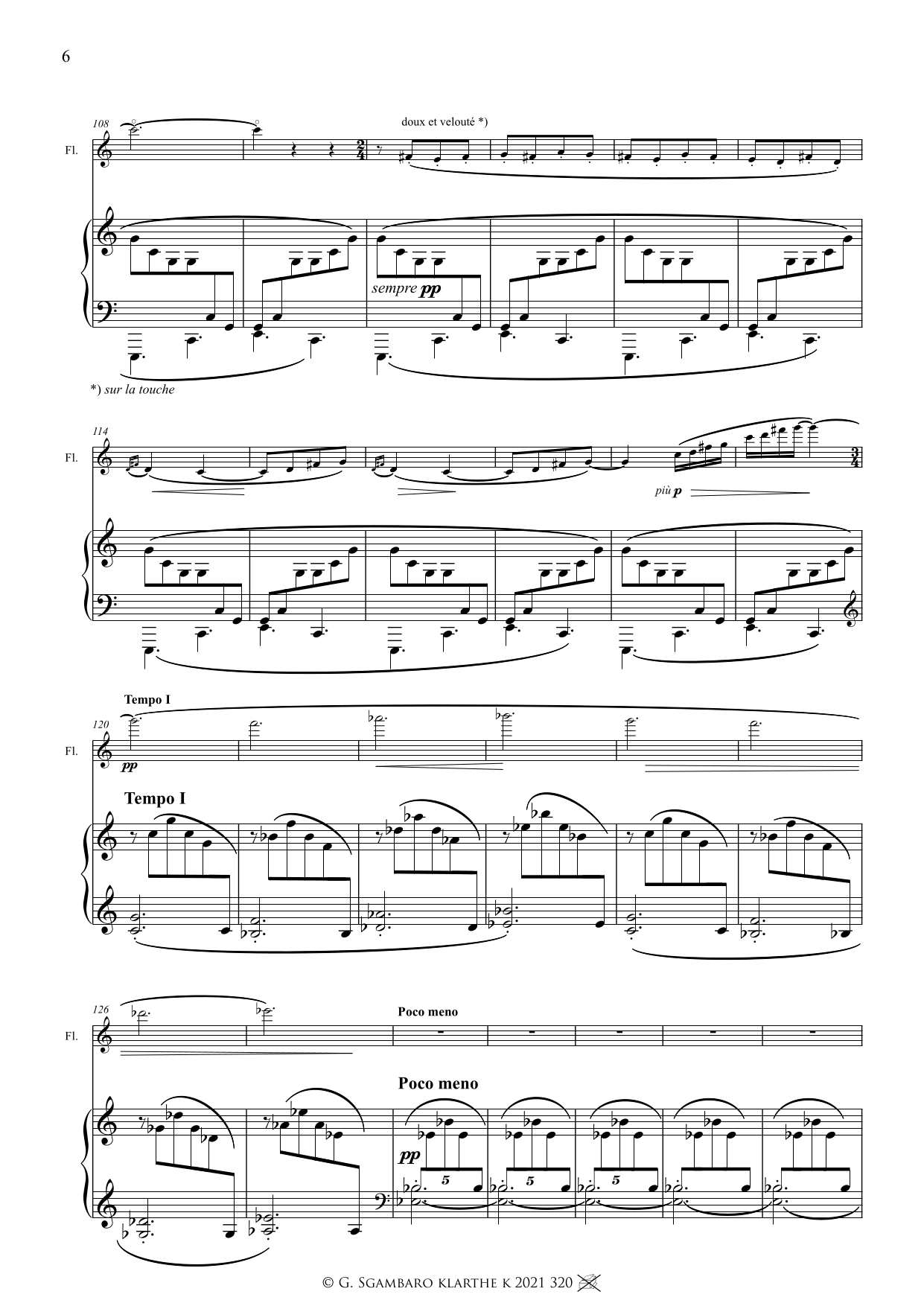
The writing of this sonata is particularly well suited to the flute, highlighting the instrument's brilliance, richness of colour, variety of articulation, and subtlety of tone.
Gionata Sgambaro
Duration: 14'

 Un flot antique de lumière
 Six Mélodies - Claude Debussy
 Fantaisie sur Tosca - Giacomo Puccini
 Pavane op. 50 - Gabriel Fauré
 Fantaisie sur Lakmé - Léo Delibes
 Carrousel - Patrick Nebbula